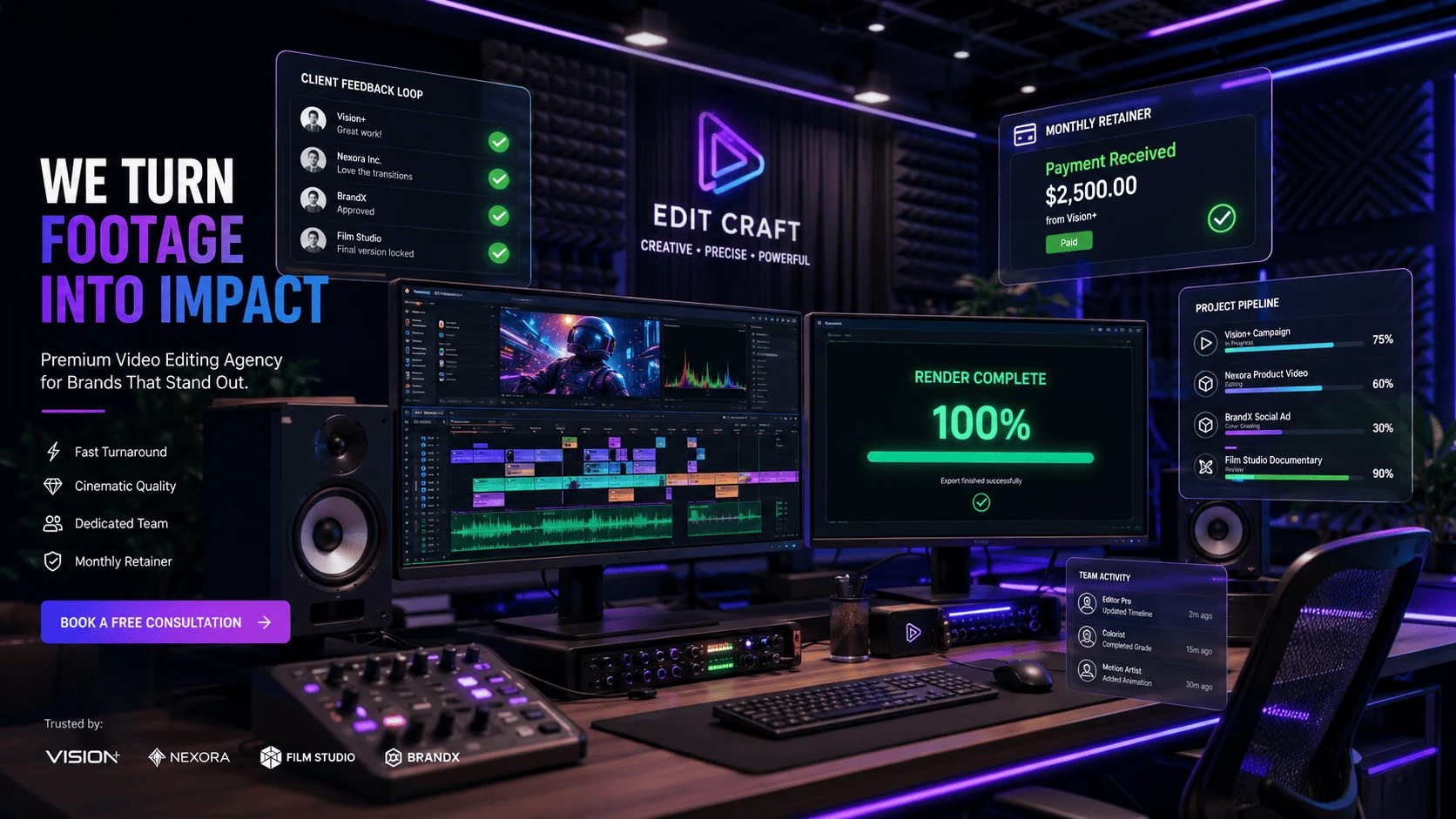
Let’s be completely honest: in 2026, everyone with a smartphone is technically a "video editor." They can cut a clip on CapCut, toss an AI filter over it, and post it to TikTok in sixty seconds. But there is a massive, yawning chasm between slapping together a casual social media reel and delivering high-converting, strategically paced video assets for brands, B2B companies, and top-tier creators.
The global demand for high-quality video content has officially broken the charts. Businesses no longer treat video as an optional marketing experiment; it is their primary engine for customer acquisition, brand awareness, and digital corporate identity. If you have a sharp eye for pacing, storytelling, and visual flow, there has never been a more lucrative time to transition from a casual freelancer into a legitimate business owner.
If you want to move away from trading time for pennies on gig sites and build a highly profitable creative agency instead, you need a blueprint. Here is your definitive, step-by-step roadmap on how to start a video editing business that survives, thrives, and scales in today's hyper-competitive landscape.
Freelancer vs. Video Editing Agency: Choosing Your Business Blueprint
Before you purchase a single piece of software or pitch a client, you need to decide what kind of business model you are building. Are you looking to remain a highly skilled solopreneur, or do you want to build a productized, scalable service?
Understanding this distinction early on will dictate your pricing, your tech stack, and your long-term growth strategy. Let's look at how these two paths stack up against each other:
| Operational Feature | The Solopreneur Freelancer | The Productized Video Agency | Business & Scaling Implications |
|---|---|---|---|
| Revenue Model | Hourly rates or varying per-project fees. | Standardized subscription packages (Monthly Retainers). | Agencies enjoy highly predictable, recurring monthly revenue (MRR). |
| Workflow Capacity | Capped by your personal time and daily energy. | Leverages a team of editors, project managers, and automated systems. | Agencies can scale production to hundreds of videos per month. |
| Client Interaction | High touch. You handle every email, revision loop, and support ticket. | Systemized through custom portals, structured feedback tools, or Slack. | Agencies decouple the founder's time from day-to-day client management. |
| Delivery Speed | Often slower due to administrative bottlenecks. | Highly optimized via step-by-step assembly lines and rendering queues. | Fast turnarounds attract high-end corporate clients willing to pay a premium. |
Key Insights: 5 Strategic Steps to Build a Profitable Editing Business
Building a modern creative agency isn't just about knowing how to slice a timeline or apply a flawless color grade. It requires a balanced combination of technical infrastructure, strategic positioning, and smart operations.
1. Building a Bulletproof 2026 Tech Stack
Your business runs on your hardware and software infrastructure. If your system crashes during a heavy 4K or 8K render, your reputation drops along with it.
The Hardware: Invest in an Apple Silicon Mac Studio/MacBook Pro or a high-end custom Windows rig with at least 64GB of RAM, a dedicated GPU, and dedicated NVMe SSD storage arrays for active project caching.
The Software: Adobe Premiere Pro and DaVinci Resolve remain the industry gold standards for collaborative editing and advanced color grading.
The Review Layer: Use platforms like Frame.io to handle frame-by-frame client feedback. This eliminates ambiguous "change the clip around the middle" emails and condenses your revision cycles down by 50%.
2. Streamlining Growth via Intelligent Workflows and AI Automation
One of the absolute biggest mistakes beginner agency owners make is spending 80% of their day on administrative fluff instead of working on growth or high-value creative direction. You have to manage file transfers, ingest footage, update client trackers, send invoices, and follow up on approvals.
To prevent early-stage burnout, modern agencies rely heavily on cloud integrations. By linking platforms like Notion, Google Drive, and Slack, you can build self-running systems. For example, when a client uploads raw footage to a specific folder, an automated workflow can instantly alert your editor, generate a time-tracked sub-task, and create a draft invoice.
If you are wondering how to string these applications together without writing complex code, digging into a comprehensive guide on what is AI automation will show you how to leverage platforms like Make or Zapier to build robust, hands-free business backends.
3. Finding Your Riches in the Niches
If you tell the market, "I edit all kinds of videos for all kinds of people," you instantly become an easily replaceable commodity. You will find yourself competing on price against thousands of low-cost alternatives online.
Instead, position yourself as the ultimate specialist for a highly specific, high-revenue industry. Consider these lucrative sub-niches:
B2B SaaS Product Walkthroughs: Explaining complex tech platforms visually. You can tie this service into broader B2B tech marketing growth strategies to help software companies boost their user retention.
High-Ticket Course Creators: Editing structured, highly engaging multi-module educational academies.
Real Estate Cinematic Tours: Premium, stylized walkthroughs for luxury property brokers.
The "Productized" Short-Form Engine: Transforming long-form podcasts into dozens of high-retention vertical clips (Reels, Shorts, TikToks) with custom motion graphics.
4. Pricing for Profitability: Escape the Hourly Trap
Never, under any circumstances, charge by the hour when running a creative business. Charging hourly actively punishes you for becoming faster, more efficient, and more experienced.
Instead, embrace Value-Based Pricing or Productized Retainers.
This model turns your creative output into a predictable, line-item business utility for your client, making it much easier for them to justify the recurring monthly investment.
5. Launching an Unstoppable Client Acquisition Engine
You can have the most breathtaking portfolio on earth, but if no one knows you exist, your business will fail. To land your first three high-paying clients, bypass generic job boards and implement a direct, personalized outreach engine.
The Audit Strategy: Identify five creators or businesses in your chosen niche whose video content has clear flaws (e.g., poor audio balancing, sluggish pacing, or boring intros).
The Safe Pitch: Edit one of their recent videos completely for free. Cut out the fluff, add dynamic text, improve the hook, and send it to them via email or Twitter DM.
The Close: Say something simple: "Hey [Name], loved your last episode, but noticed the pacing slowed down in the middle. I re-edited this 60-second clip to maximize your viewer retention. If you want your future content to look like this every week without lifting a finger, let’s chat."
Overcoming the "Scale Wall": Transitioning to an Executive Role
As your client base grows, you will inevitably hit the "Scale Wall." This is the point where you have zero hours left in the day to edit more footage yourself. This is the ultimate test of your business journey.
To break through, you must transition from the technician who edits to the CEO who oversees the system. Start by hiring a talented junior editor to handle the rough cuts and primary assembly lines, while you focus 100% of your energy on final quality control, creative direction, and strategic client acquisition.
By standardizing your operational guidelines, setting clear formatting rules, and utilizing shared asset templates, your business will continue to deliver flawless results even when your own hands are completely off the keyboard.
Conclusion
Learning how to start a video editing business isn't an overnight shortcut to wealth—it requires dedication, continuous skill development, and an organized approach to operations. However, by breaking away from chaotic freelance habits, defining a clear niche, and implementing automated workflows, you can build a highly resilient asset that rewards you with both creative freedom and financial predictability. Stop editing your life away for pennies; build the engine instead.
Now, let’s hear from you!
Which specific video editing niche do you think holds the highest profit potential this year? Are you planning to start as a solo freelancer or dive straight into building an agency team? Drop your thoughts, questions, or current challenges in the comments section below!
If you want to receive weekly, under-the-hood breakdowns on scaling creative agencies, landing premium retainers, and mastering advanced production workflows, subscribe to our Creative Agency Growth Newsletter today!