
Remember when automation simply meant setting up an email autoresponder or scheduling a weekly social media post? Back then, it felt like magic. You created a rigid rule-If X happens, do Y-and the machine executed it flawlessly. But what happened if a customer replied with a nuanced question, or an attached invoice was missing a line item? The system broke down instantly.
Fast forward to 2026, and those rigid systems are rapidly becoming relics of the past. Today, if your business infrastructure cannot think, adapt, or learn from its mistakes, it is already falling behind. This shift brings us to the core question dominating the modern corporate landscape: What is AI automation, and why is it suddenly the defining competitive edge for enterprises and startups alike?
In this comprehensive guide, we will break down the mechanics of intelligent automation, map out how it differs from traditional software, explore key insights driving the industry, and look at practical steps to deploy it in your workflow.
Traditional Automation vs. AI Automation: The Cognitive Leap
To truly grasp what is AI automation, we must first draw a line between the old way of doing things and the new cognitive era.
Traditional automation, often referred to as Robotic Process Automation (RPA) or simple "If-This-Then-That" (IFTTT) logic, is entirely deterministic. It relies on explicit code. If the data incoming does not perfectly match the predefined template, the automation fails.
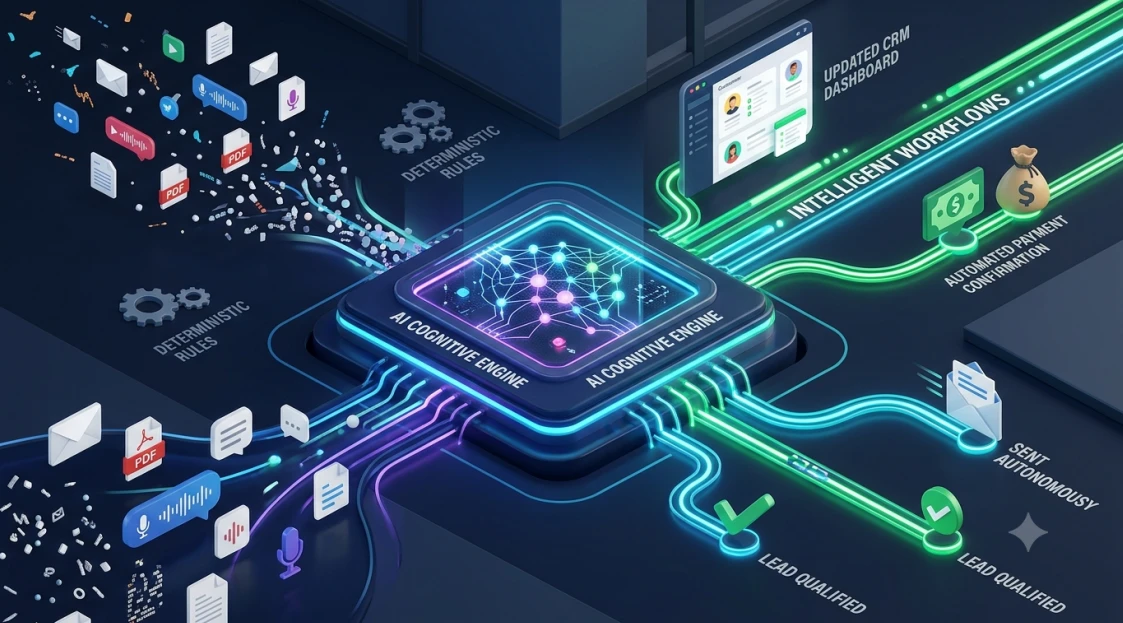
AI automation, on the other hand, introduces an element of cognitive reasoning. Powered by modern Large Language Models (LLMs), machine learning algorithms, and computer vision, it interprets unstructured data—like unstructured emails, audio recordings, or handwritten PDFs-and makes informed decisions on the fly.
Here is a side-by-side comparison to help visualize this paradigm shift:
Operational Feature | Traditional Automation (Deterministic) | AI Automation (Cognitive) | Direct Business Impact |
|---|---|---|---|
Data Handling | Only processes structured data (e.g., clean Excel sheets, database inputs). | Excels at unstructured data (e.g., loose emails, voice notes, images, PDFs). | Eliminates manual data entry and sorting overhead. |
Decision Making | Strictly follows binary rules. Cannot handle exceptions without crashing. | Reasons through ambiguity using contextual comprehension. | Dramatically reduces system errors and manual human interventions. |
Adaptability | Requires manual recoding if a software interface or format changes. | Automatically learns from new data patterns and adapts seamlessly. | Lowers long-term maintenance and software development costs. |
Human Interface | Interacts via rigid APIs, forms, or clicked web elements. | Communicates through natural language, semantic understanding, and voice. | Delivers a superior, frictionless user and customer experience. |
Key Insights: How AI Automation Actually Works
Now that we know the differences, let’s peek under the hood. How does a modern AI automation pipeline operate? Leading workflow orchestration platforms like Make's AI Automation Hub demonstrate that intelligent workflows typically follow a three-step cycle: Ingest, Reason, and Execute.
1. The Ingestion Stage (Unstructured to Structured)
Every minute, your business receives a chaotic influx of data. Customers send messy emails, vendors drop scanned receipts, and leads leave ambiguous feedback on social platforms. AI automation uses tools like Optical Character Recognition (OCR) and Natural Language Processing (NLP) to read, categorize, and clean this information without human eyes ever touching it.
2. The Reasoning Stage (The LLM Brain)
Once the data is parsed, it hits the cognitive engine. In 2026, businesses routinely connect their internal databases to advanced LLMs using Retrieval-Augmented Generation (RAG). The AI doesn’t just read the email; it understands the sentiment, checks your current inventory or CRM system, and decides the best logistical path forward.
For instance, if you are looking to integrate specialized communication flows into this step, deploying a native AI Voice Agent for automated customer service can bridge the gap between digital reasoning and human-like spoken interaction smoothly.
3. The Execution Stage (Action via APIs)
An idea without execution is useless. Once the AI decides what needs to happen (e.g., "The customer qualifies for a full refund under policy section 4"), it automatically talks to your payment gateway, updates your accounting software, logs the interaction in HubSpot, and drafts a polite confirmation email to the user. All of this happens in less than three seconds.
Driving Massive ROI: Where AI Automation is Winning in 2026
Implementing AI automation isn't about chasing a tech trend; it's about optimizing resource allocation. According to recent tech adoption benchmarks published by the Gartner Emerging Technologies Research, companies utilizing cognitive workflows have slashed operational bottlenecks by up to 60%.
Let's look at three core domains where this technology is transforming modern business operations:
B2B Marketing and Smart Lead Qualification
Gone are the days of manually scraping lists and sending generic email blasts. AI workflows now track real-time buyer intent data, automatically craft highly hyper-personalized outbound sequences based on a prospect's recent LinkedIn activity, and qualify leads dynamically. To see how these automated flows fit into a broader ecosystem, check out our blueprint on B2B tech marketing growth strategies to scale your sales funnel.
Dynamic Advertising and Visibility Metrics
Running paid campaigns used to require hours of continuous manual performance analysis. Today, AI automation monitors your ongoing ad spend, identifies creative fatigue, updates target demographics autonomously, and maximizes your return on ad spend. You can pair these automated triggers with proven frameworks like Google click advertising for brand visibility to build a self-optimizing marketing machine.
Enterprise Efficiency and Upskilling
A common anxiety surrounding the rise of automation is job displacement. However, the true narrative of 2026 is one of human empowerment. By offloading mundane cognitive tasks to automated agents, human workers are freed to focus on strategic, creative, and interpersonal challenges.
As the demand for architects who can design these workflows skyrockets, upskilling has become critical. Professionals looking to validate their technical expertise in managing and deploying these complex automated frameworks are increasingly leveraging specialized programs, such as the CBT&A Level-4 comprehensive certification, to stay ahead of the competitive curve.
Overcoming the Roadblocks: A Candid Reality Check
While the potential of AI automation is massive, it would be disingenuous to pretend it is a flawless plug-and-play solution. If you want your implementation to succeed, you must navigate three major hurdles:
- Data Silos: If your internal data is scattered across legacy systems, your AI engine will hallucinate or make poor decisions. Clean your data before you automate.
- Security Concerns: Passing sensitive user data to public AI models is a recipe for compliance disasters. Always prioritize enterprise-grade, secure API endpoints that guarantee data privacy.
- The Over-Automation Trap: Not every process needs an AI brain. If a task is completely simple and binary, a traditional, low-cost script or standard webhook remains the faster and more cost-effective choice.
If you are just getting started on building the digital infrastructure required to host these automated apps and portals, walking through a foundational tech roadmap—such as our tutorial on how to build a professional WordPress website with Claude AI—can provide a solid, accessible starting point for anchoring your web integrations.
Conclusion
Understanding what is AI automation is the first step toward future-proofing your business model. We have officially moved past the era of rigid software that merely mimics actions; we are now building systems that understand intent. By integrating cognitive reasoning into your daily workflows, you don't just save time—you build an scalable infrastructure capable of evolving alongside your market.
What are your thoughts?
Which repetitive task in your current daily workflow do you wish an intelligent AI assistant could handle for you right now? Let us know in the comments section below!
If you want to stay ahead of the curve with actionable automation blueprints, deep tech insights, and step-by-step guides delivered straight to your inbox, subscribe to our Future-Proof Operations Newsletter today!