How to Write an IT Resume That Gets You Noticed by Top Employers
The average tech recruiter spends exactly six seconds looking at your resume before deciding whether to "Keep" or "Trash" it. In those six seconds, your life’s work, your late-night coding sessions, and your professional certifications are judged. In the hyper-competitive market of 2026, where AI filters are the first line of defense, knowing how to write an IT resume that gets you noticed by top employers is no longer a soft skill-it is a survival skill.
Whether you are a developer in Dhaka or a systems architect looking for remote work in Silicon Valley, your resume needs to be more than a list of duties; it needs to be a high-converting sales page for your expertise.
1. The 2026 Shift: Understanding the "Machine Gatekeepers"
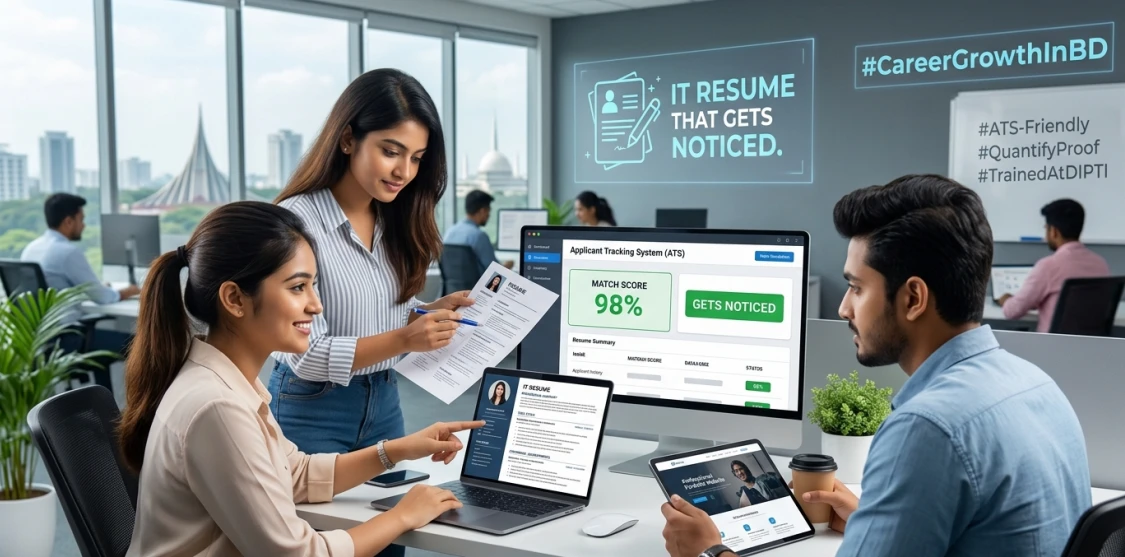
Before your resume ever reaches a human being, it must pass through an Applicant Tracking System (ATS). In 2026, these systems have evolved. They don’t just look for keywords; they use natural language processing (NLP) to understand the context of your experience.
If you keyword-stuff your resume like it’s 2015, the "Machine Gatekeeper" will flag you for low quality. According to research on modern hiring trends, nearly 75% of resumes are rejected by ATS before a human recruiter even sees them. To pass, your resume must be clean, standard, and highly relevant to the specific job description.
2. The Anatomy of a High-Impact IT Resume
A successful IT resume follows a specific hierarchy of information. Here is the blueprint for 2026.
The Professional Summary (The "Elevator Pitch")
Skip the "Objective" statement. Top employers don't care what you want; they care what you can do for them.
- Bad: "Looking for a challenging role in a dynamic IT company."
- Good: "Senior Full-Stack Developer with 6+ years of experience specializing in scalable React/Node.js applications. Reduced server latency by 40% for a fintech startup."
The Skills Matrix
Don't just list a wall of text. Group your skills so they are scannable for both humans and bots.
- Core Tech: JavaScript (ES2026), Python, Go, Rust.
- Frameworks: Next.js, Django, TensorFlow.
- Tools/DevOps: Docker, Kubernetes, AWS (Lambda, S3), Jenkins.
Experience: Outcomes Over Activities
This is the most critical section. Most IT resumes fail because they list responsibilities instead of achievements.
- Weak: "Responsible for maintaining the company website."
- Strong: "Optimized website performance using Core Web Vitals, resulting in a 25% increase in organic search traffic over six months."
3. Comparison: Traditional Resume vs. The 2026 Tech Resume
How has the standard changed? Use this table to audit your current document.
Feature | The Old Way (Pre-2023) | The Modern Tech Way (2026) |
|---|---|---|
Length | 2-3 pages for everyone | 1 page (Junior) / 2 pages (Senior) |
Format | Creative layouts, tables, images | Clean, single-column, ATS-friendly |
Focus | Job duties and descriptions | Quantifiable metrics and ROI |
Portfolio | Mentioned at the bottom | Hyperlinked in the Header |
AI Content | None | AI-assisted but human-refined |
4. Key Insights: The Three "Unfair Advantages"
To truly get noticed, you need to include elements that 90% of other applicants forget.
Insight 1: Quantifiable Proof
In tech, numbers speak louder than words. Use the Google XYZ Formula: "Accomplished [X] as measured by [Y], by doing [Z]."
- Example: "Scaled a database [X] to handle 1 million concurrent users [Y] by implementing Redis caching [Z]."
Insight 2: The "Link-Heavy" Strategy
Top employers want to see your code, not just read about it.
- GitHub/GitLab: Ensure your "Green Square" contribution graph is active.
- Portfolio/Live Links: If you built it, link to it. A live URL is the ultimate proof of competence.
- LinkedIn: Your resume and LinkedIn should tell the same story. Many recruiters use LinkedIn Recruiter to cross-verify your claims.
Insight 3: Continuous Learning (The NSDA Factor)
The IT world changes every six months. In Bangladesh, showing that you have stay updated through recognized bodies is vital. Including an NSDA-certified training or a professional diploma from a reputable institute like DIPTI shows that you aren't just self-taught—you are industry-validated.
5. Tailoring: The 80/20 Rule
You should never send the same resume to two different companies.
- 80% Core: Keep your basic structure and history the same.
- 20% Custom: Change your Professional Summary and "Key Skills" to mirror the exact language used in the job post. If the job post asks for "Cloud Infrastructure," make sure those exact words appear in your summary.
6. Common Red Flags to Avoid
Even a great developer can be rejected for these simple mistakes:
- Broken Links: Nothing says "poor attention to detail" like a 404 error on your portfolio link.
- Unprofessional Email: Use [email protected]. Avoid [email protected].
- PDF vs. Word: Always send a PDF. It preserves your formatting across all devices.
- Fluff Phrases: Avoid "hard-working," "team player," or "self-motivated." These are "empty" words. Prove them through your experience instead.
7. Start Your Career Transformation at DIPTI
Writing a great resume is easy when you have great experiences to put on it. At the Daffodil International Professional Training Institute (DIPTI), we focus on building "Resume-Ready" skills.
Whether you are taking our Digital Marketing course or our Web Development track, our curriculum is designed around real-world projects. We don't just provide a certificate; we provide the case studies and technical depth that make your resume impossible to ignore. Our dedicated placement cell also provides career counseling and mock interview sessions to help our students land their dream roles.
8. Frequently Asked Questions (FAQ)
Should I include a photo on my IT resume?
In Bangladesh, it is still common, but for international or remote roles (US/UK/EU), do not include a photo. Many international companies have "blind hiring" policies to avoid bias and will automatically reject resumes with photos.
How far back should my work history go?
Focus on the last 10 to 15 years. For the tech industry, anything older than 10 years (unless it's at a major firm like Google or Microsoft) is likely using obsolete technology.
What if I have a gap in my employment?
Be honest but strategic. If you spent six months learning a new language or contributing to open-source projects, list that as "Independent Professional Development" or "Freelance Project Work."
Your Resume is a Product. Treat it Like One.
A bug-free, optimized resume is the first "software" you deliver to an employer. If you want to get noticed, make sure your resume is as efficient, clean, and high-performing as the code you write.
Ready to add high-demand skills to your resume?
Explore DIPTI’s Professional Courses Today and start building a portfolio that recruiters can't resist.